Understanding Cost of Production for Smallholder Coffee Farmers
At Que Onda, we work closely with smallholder producers in Mexico and Peru. Our sourcing model is built around them, so this article focuses on the realities they face in managing the true cost of producing coffee. While the industry often speaks broadly about “cost of production”, the specific dynamics for small-scale, family-run farms are distinct and critically important to understand if we want a sustainable future for specialty coffee.
The Strength of Smallholders: Incentives and Efficiency
One of the advantages smallholder farmers have over larger estates is the absence of what economists call diseconomies of hierarchy. Put simply, bigger farms require layers of management: supervisors, administrators, and salaried employees who might not always share the same long-term incentives as the owners.
Family farms, on the other hand, operate on a completely different logic. Labour is performed by people who own the land, care deeply about its future, and understand the stakes. Their alignment of incentives means tasks are carried out with care, efficiency, and continuity. There is no need for salaried oversight or external supervision; instead, there is collective responsibility and intergenerational investment.
This doesn’t make smallholder production cheap but it does mean that the structure of costs looks different.
Agricultural Inputs: A Growing and Variable Expense
Agricultural inputs represent a significant portion of a farm’s expenditure. Fertilisers, organic matter, pesticides or bio-alternatives, tools, compost, and soil amendments all come with costs that fluctuate based on:
Local and global prices
Pest and disease pressure
Soil and climate conditions
Yield expectations
Farmers’ budgets
Risk tolerance
Long-term sustainability goals
Decisions about inputs are rarely straightforward. For example, environmentally friendly solutions may support soil health and long-term resilience, but they often require more labour or carry higher upfront costs. Meanwhile, chemical inputs can offer short-term protection but at the expense of ecological balance and future soil fertility.
Every producer must weigh these factors carefully and smallholders often do so with limited cash flow and without access to agronomic credit.
The Hidden Costs: Fixed Assets and Depreciation
One of the most overlooked aspects of cost of production is depreciation. Few small-scale producers today are calculating their fixed costs, including the value of their coffee trees over time. A coffee tree begins to bear fruit after about three years, reaches peak productivity a few years later, and eventually declines. Replanting, renovating, and maintaining a healthy farm require long-term investment, yet this is rarely included in the final “cost per kilo” that farmers quote to buyers.
Without accounting for depreciation, producers may unintentionally underprice their coffee, making it impossible to reinvest in the next generation of trees.
Harvest Labour: The Largest and Rising Cost
In many producing regions, harvesting labour accounts for up to 70% of total production costs, especially where all picking is done by hand. The challenges around labour are intensifying:
Younger generations often migrate to cities
Alternative employment opportunities offer higher or more stable income
Rural populations are shrinking
Seasonal migration patterns are changing
Rising wages, while important for workers, place pressure on farm profitability
This structural labour shortage means that in some regions, the cost of production has increased drastically. In others, coffee farming is simply becoming unviable because pickers are not available at any cost.
The issue is not only economic, it is demographic and social.
Why Understanding Cost of Production Matters
To make these dynamics more concrete, we’ve included an example cost-of-production breakdown based on a smallholder coffee farm. While every farm is different, this illustrates how labour, inputs and fixed costs interact in practice.
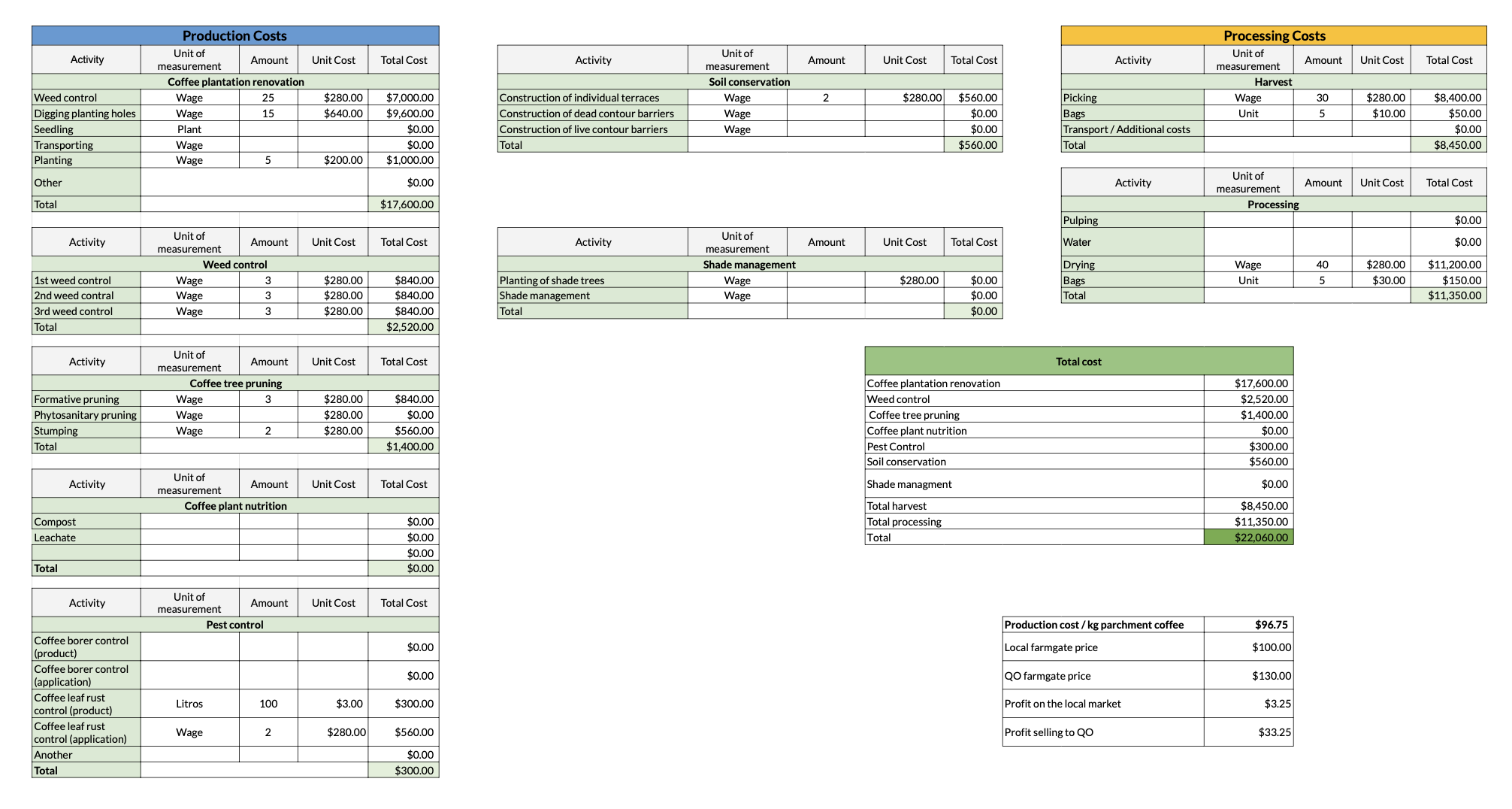
Que Onda COP template (currency: Mexican Pesos)
For buyers, roasters, and consumers, understanding cost of production isn’t about extracting numbers from producers. It’s about respecting the complexity of their work and recognising that price stability and long-term relationships depend on accurate costing.
Smallholders cannot carry the burden of rising input prices, labour shortages, climate challenges, and market volatility alone. Transparent, realistic discussions about cost of production are essential if we want:
Fair pricing
Sustainable farming communities
High-quality coffee year after year
Regeneration rather than depletion of landscapes
Intergenerational continuity in farming families
At Que Onda, we are committed to supporting producers as they navigate these pressures. Understanding their realities is the first step. Paying prices that truly reflect the cost and value of their work is the next.